opsgentic
OpsGentic — Architecture
How OpsGentic turns an alert into a reviewed GitOps pull request. For setup see the Quickstart; for day-to-day operation see USAGE.md.
Overview
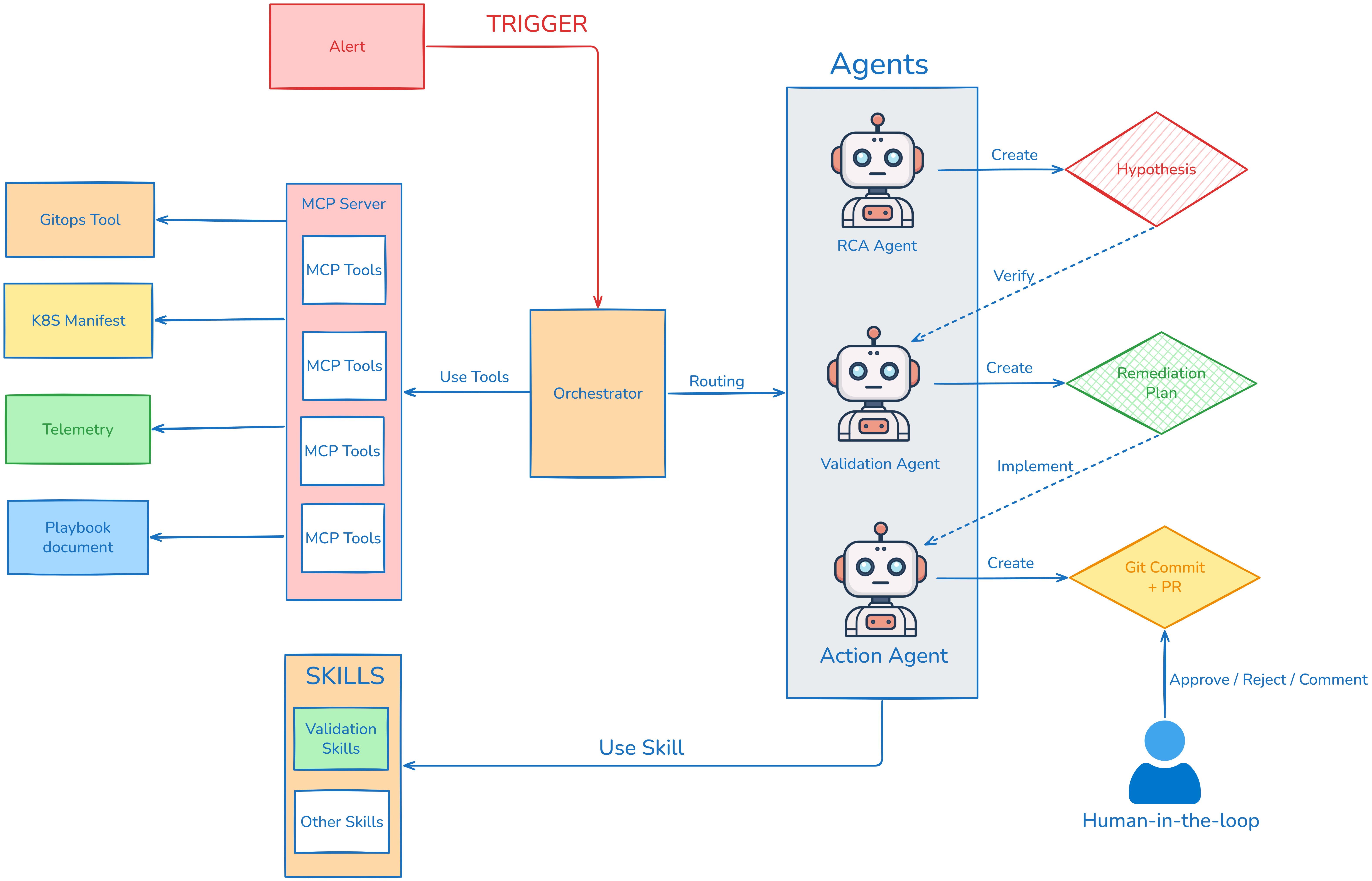
A trigger (a Grafana/Alertmanager alert or a user chat message) hits the API, which enqueues
the run on a Postgres-backed task queue and returns 202 { thread_id, status, poll_url }. A
worker consumes the job and runs a stateful LangGraph
graph across three core agents:
- RCA Agent — enriches context (via read-only MCP tools) and produces a root cause hypothesis.
- Validation Agent — verifies the hypothesis using deterministic Validation Skills, then drafts a remediation plan.
- Action Agent — opens a Git commit + pull request so a GitOps controller (ArgoCD/Flux) can apply the change.
Two tool layers feed the agents:
- MCP Servers (read-only) — reused open-source MCP servers (
kubernetes-mcp-serverfor the cluster,github-mcp-serverfor the repo) for querying cluster/observability/repo state. No mutation happens here; writes only occur through GitOps. - Validation Skills — plain-Python business logic the Validation Agent calls directly, independent of MCP.
Agent instructions are not hard-coded: each agent composes its system prompt from an editable
agent-skill library. The Action Agent never opens a PR autonomously — the graph
pauses at an interrupt_before gate for human approval (unless AUTO_APPROVE=true, where PR
review/merge becomes the gate).
Async execution & the task queue
OpsGentic decouples the API from the (minutes-long) agent run:
- The API enqueues the run on a Postgres-backed task queue (Procrastinate) and returns
202immediately. - A separate worker Deployment consumes the queue and drives the graph, recording the lifecycle (
queued → running → awaiting_approval → applied/failed) in anopsgentic_runstable. - Clients poll
GET /runs/{thread_id}for status + state. - The queue reuses the same Postgres used for durable checkpoints — no extra broker, identical locally and on Kubernetes.
- Without
DATABASE_URL(local/dev) there is no queue: the API runs the graph synchronously in-process and returns the full result, and the CLI runs it directly.
Machine state & graph flow
trigger -> [enqueue] -> worker:  RCA -> resolve_target -> Validation -> [interrupt_before] -> Action -> END
                                            |                                  ^
                                            +-- (fail / unresolved repo) ------+ (self-heal loop)
- RCA reads
alert_payload, gatherscontext_data, writeshypothesis. - resolve_target maps the alerting workload to its GitOps repo/path (see Multi-repo resolution).
- Validation runs the Validation Skills. On pass (and a resolved repo) it drafts a
remediation_planand setsexecution_status="awaiting_approval". On fail or unresolved repo it loops back to RCA up toMAX_RCA_ATTEMPTS, then escalates. - The graph pauses before
action(interrupt_before=["action"]); state is persisted by the checkpointer keyed onthread_id. No PR exists yet. - A human approves (or
AUTO_APPROVE=true); the run resumes and the Action Agent opens (or updates) the remediation PR.
State survives restarts via a durable PostgresSaver checkpointer (DATABASE_URL); without it, an in-memory checkpointer is used (single process, dev only).
Remediation: surgical edits, convergence on re-fire
The Action Agent reads the resolved repo via github-mcp-server and proposes surgical field
edits (forced via structured output), which OpsGentic applies to the real manifest with
comments/formatting preserved (ruamel). If no edits can be produced, it falls back to a
remediations/<key>.md proposal.
A stable issue key (repo|file|alertname|namespace) drives a deterministic branch, so a
re-fired alert does not open a duplicate PR. Instead OpsGentic converges (GitHub):
- It reads what the open PR already proposes (the
base...branchdiff) and asks the agent whether that already resolves the alert. - Sufficient → it posts one comment, no new commit.
- Insufficient → it commits a single incremental edit on the branch.
This avoids the divergent-commit churn from regenerating a (non-deterministic) fix on every re-fire.
Agent skills
Agent instructions live in an editable markdown library instead of hard-coded prompts:
deploy/manifests/agent-skills/{sre,gitops,validation,code}.md— each has YAML frontmatter (name,description,agents: [...]) plus a markdown body.- A skill is wired to agents via its
agentsfield; the loader (agent_skills.py) composes the bodies of all skills targeting an agent into its system prompt. Code-bound mechanics (the remediation edit schema, the resolver index-only answer) stay in code. - Wiring:
rca/context→sre;remediation→sre + gitops + validation + code;resolver→gitops. - Delivery: shipped as the
opsgentic-skillsConfigMap (mounted at/app/agent-skills), so prompts are tunable without an image rebuild (a baked-in copy is the fallback). See USAGE.md → Editing agent skills.
Multi-repo resolution
OpsGentic maps an alert to the GitOps repo/path that owns the affected workload, so one deployment serves many repos. Resolution chain (first match wins):
- Explicit alert labels
gitops_repo/gitops_path(override / fast path). - ArgoCD — the
Applicationwhosestatus.resources(or destination namespace) contains the workload →spec.source.repoURL+path+targetRevision. - Flux — the workload’s
kustomize.toolkit.fluxcd.io/{name,namespace}labels →Kustomization→GitRepositoryURL + path. - Unresolved → escalate (OpsGentic does not guess a repo).
The workload identity is derived from alert labels (workload/deployment/app, or the pod name
with its replicaset/pod suffix stripped). Discovery is deterministic — CRDs are read read-only
through the kubernetes-mcp-server; on an equal-confidence tie the LLM picks among candidates.
The resolved host selects a provider from the registry (config/gitops.yaml): each git host maps
to a type (github / gitea / gitlab), an API base, and the env var holding that provider’s
token. Auth: a fine-grained PAT (GITHUB_TOKEN) is simplest; a GitHub App is preferred for
production (short-lived installation tokens). See USAGE.md → Configuration.
Components
- Orchestrator & agents (
src/opsgentic/graph) — LangGraphStateGraphover a typedMachineState;interrupt_beforeapproval gate. - Validation Skills (
src/opsgentic/skills) — deterministic Python checks, decoupled from MCP. - Agent skills (
deploy/manifests/agent-skills,src/opsgentic/agent_skills.py) — editable markdown prompt library composed per agent. - MCP servers & tooling (
mcp-config/,deploy/manifests/mcp/,src/opsgentic/mcp) — the read-only gateway for cluster + repo reads (no direct k8s client, no kubectl). - GitOps (
src/opsgentic/gitops) — alert→repo resolver, provider registry, PR create + re-fire convergence, remediator, YAML editing. - Task queue & worker (
src/opsgentic/tasks.py,runs.py,worker.py) — Procrastinate over Postgres; the API enqueues, the worker executes. - Deployment manifests (
deploy/manifests/) — namespace, read-only RBAC, MCP servers, Postgres, ConfigMap/Secret, API + worker Deployments, Service.
Project layout
src/opsgentic/
  config.py             # Settings (env-driven)
  agent_skills.py       # markdown agent-skill loader (frontmatter -> per-agent prompt)
  agents/llm.py         # ChatOpenAI factory pointing at vLLM
  graph/
    state.py            # MachineState (TypedDict)
    builder.py          # StateGraph wiring + interrupt_before
    nodes/              # rca / resolve_target / validation / action
  skills/               # deterministic Validation Skills (Python)
  mcp/                  # MCP loader + read-only context enrichment
  gitops/               # resolver, provider registry, PR create + convergence, remediator, yamledit
  triggers/normalize.py # Grafana + chat -> alert_payload
  runner.py             # enqueue (async) + execute (sync) + status tracking
  tasks.py              # Procrastinate app + tasks (run_alert / resume_run)
  runs.py               # opsgentic_runs status table
  worker.py             # queue worker entrypoint (opsgentic-worker)
  main.py               # FastAPI service (async, 202 + polling)
  cli.py                # local runner (synchronous)
mcp-config/             # MCP server config (servers.yaml)
config/gitops.yaml      # git provider registry (host -> provider/token)
deploy/manifests/       # K8s manifests + agent-skills/ (-> ConfigMap)
docs/                   # ARCHITECTURE.md, USAGE.md, figures/